

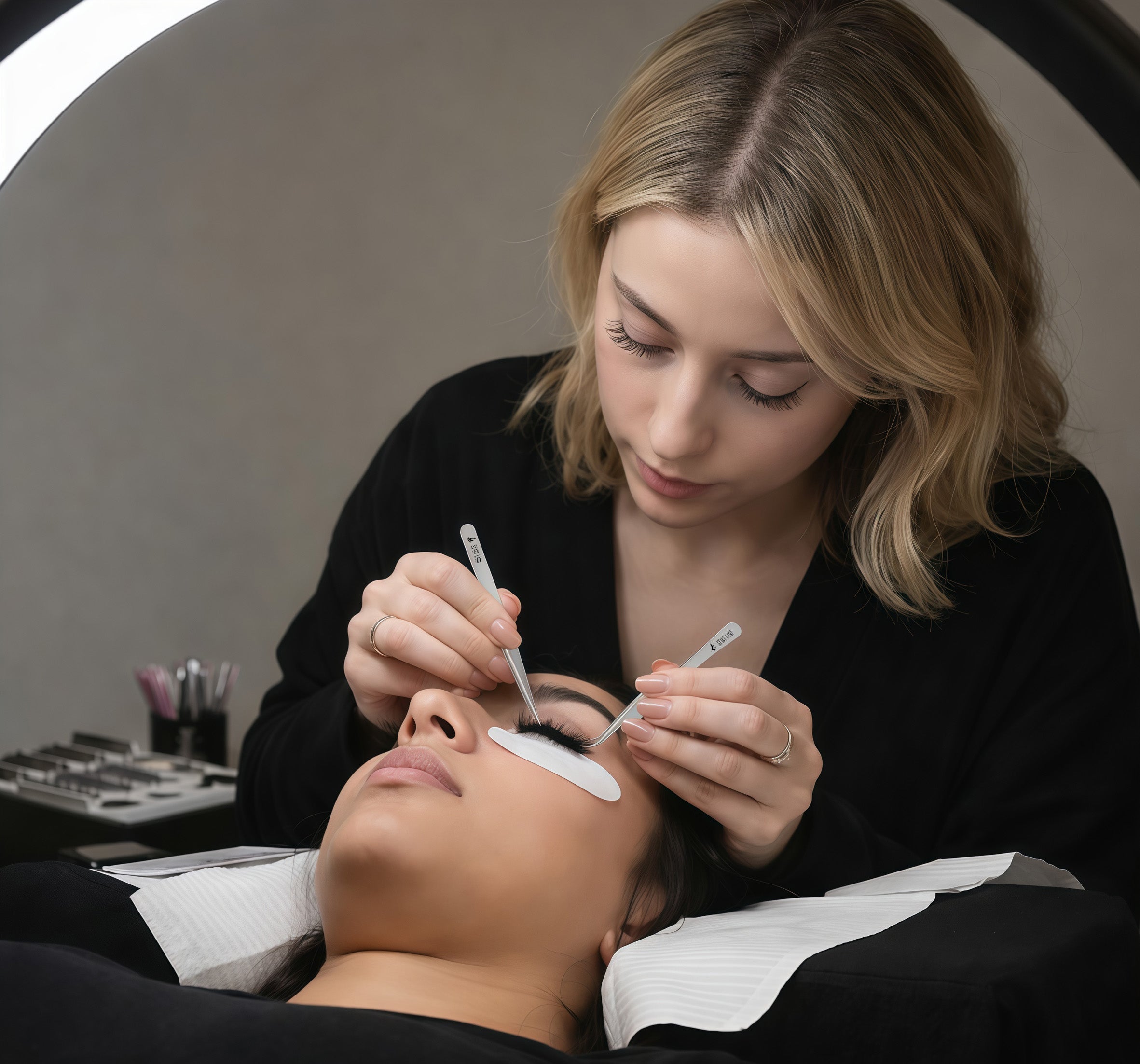
The 5-Year Trap: Why Experienced Lash Artists Stop Improving
Every lash artist remembers the early days. You’re hungry, curious, glued to tutorials at 2 a.m., testing curls on mannequin heads like dr. Frankenstein. Every client feels like a mini championship match. You’re learning fast, stumbling upon obstacles, fixing errors, leveling up again. It’s messy, chaotic, and honestly kind of fun. Then somewhere down the road — usually around year four or five — the music changes.
The schedule is full. The hands move faster. Clients are loyal. Bills are paid. On paper everything looks golden. But deep inside? Something’s stalled out. Welcome to what a lot of seasoned artists quietly run into: the 5-Year Trap.
It’s not lash industry burnout exactly. It’s not failure either. It’s more like creative cruise control. You’re still good — maybe even great — but improvement slows to a crawl. The workday becomes predictable. You stop experimenting. The same sets, the same clients, the same rhythm, day after day.
It’s just like a band that had one killer album and then just keeps playing the greatest hits at every concert. The crowd still sings along… but the band stopped writing new music years ago. And that’s the trap.
What the 5-Year Trap Actually Looks Like
The tricky part? This phase doesn’t show up waving a red flag. It sneaks in quietly, like background noise. From the outside, everything looks fine. Booked schedule, good reviews, regular clients. But inside the artist’s workflow, things start to flatten out.
Let’s be honest — comfort feels good. But as the time goes by, it just turns into a quicksand. By year five you know yourstuff perfectly, but comfort has a dark side. Stay there too long and suddenly you’re running the same play every game. No experimentation, no creative risks, no pushing technique.
And in this world, staying still is basically moving backward. One minute everyone’s doing classsic sets; next minute textured wet sets are blowing up, wispy mapping is everywhere, and someone on Instagram is building mega fans that look like architectural projects.
Meanwhile, artists stuck in the comfort zone are still doing the same map they perfected in 2019.
Routine vs Progress
Here’s a truth that stings a little: Busy doesn’t always mean growing. A tight schedule can actually lock artists into a loop. When you’re working client after client, five days a week, there’s no time to pause and rethink technique. You show up. Lash. Repeat. It becomes muscle memory. Yeah, muscle memory isn’t the villain — every skilled profession depends on it. But when the brain checks out and the hands just run the program, creativity packs its bags and leaves the building. You’re not improving anymore, you’re maintaining. And maintenance mode is where careers quietly plateau.
Signs You’re in the Trap (Even if Your Calendar Is Booked Solid)
A lot of artists assume stagnation means losing clients. But the truth is sneakier than that. You can be fully booked and still stuck. Here are some classsic signals:
- The Income Ceiling
At first, every year your income climbs. You raise prices. You get faster. Your client list grows. Then one day… it levels off. You’ve maxed out your working hours. Your market won’t support another big price jump. Your body definitely isn’t thrilled about adding a sixth workday. Welcome to the income ceiling.
And this is where artists start realizing something important: working harder isn’t the answer anymore. You can’t grind your way past every plateau. Sometimes the only way out is through.
- Creative Fatigue
Remember when you used to stare at a client’s eye shape and think: “Okay… cat eye? Wispy? Something editorial? Let’s play.”
Now it’s more like: “Alright, same hybrid set as last time.”
That spark? The one that made lash artistry feel like, well… art? It dims. It’s not that you forgot how to design beautiful sets. It’s that the work stopped challenging you. Creative fatigue hits when the brain stops asking “what if?” Instead, it just goes through the motions.
- Client Sameness
Loyal clients are gold. No argument there. But if every person in your chair asks for the exact same stylef — same length, same curl, same mapping — your creative muscles stop stretching. Imagine a chef who cooks the same pasta dish every night for ten years. Sure, they’ll make the world’s most efficient pasta. But creativity? That’s locked in the pantry. Great artists thrive on variety. New eye shapes. New stylefs. New challenges. Without that variety, skills get dusty.
- The Missing Feedback Loop
In the early days, feedback comes from everywhere. Trainers correct your technique. Clients notice changes. You ask questions constantly. Fast-forward a few years and that loop disappears. Clients assume you know what you’re doing. Peers stop critiquing your work. You stop asking. Thus, without feedback, improvement slows down fast.
Why “More Practice” Won’t Fix It
This is where a lot of artists fool themselves. They think the solution is simple: “I’ll just keep practicing.” But repetition alone doesn’t create lash artist career growth. A basketball player shooting the same free throw for 10 years isn’t automatically improving. They’re reinforcing whatever habit they already have — good or bad. The same goes for lash work. If you repeat the same technique thousands of times without reflection, you’re not developing. You’re just rehearsing. And sometimes, you’re rehearsing mistakes.
How Top Lash Artists Break Out of the Trap
The artists who stay relevant for 10, 15, even 20 years all have something in common: they refuse to stop seaking perfection. They keep learning like they’re still in year one. Here’re the ways out, step-by-step.
1. Skill Diversification
Sometimes the cure for boredom is simply new terrain. Branching into related services — brows, lash lifts, advanced volume techniques — can shake the brain out of autopilot. Different techniques challenge your coordination, precision, and creativity in new ways. Suddenly your brain is awake again. And by the way, learning something new feels good.
2. Teaching Others
Here’s a funny twist: teaching often makes you better. Explaining technique forces you to slow down and analyze every step. When you teach, you realize how many tiny decisions go into a good set. And suddenly your own work sharpens. Plus, mentoring newer artists reminds you how far you’ve come. And sometimes that perspective is exactly the kick in the pants you needed.
3. Building a Personal Brand
Some artists evolve not by adding services, but by defining their identity. Specialization turns a lash artist into a destination. And when your work has a signature stylef, clients start seeking you out for that specific look. That’s when your career shifts from service provider to industry voice.
Turning a Lash Job Into a Lash Career
Here’s the real difference between artists who last and artists who plateau: one group treats lashing like a daily job. The other treats it like a long game.
Careers require evolution. Artists who stay curious ride those waves. Artists who stay comfortable get stuck watching from the shore. It’s the same lesson every creative industry learns sooner or later.
If you keep doing the exact same thing year after year, eventually the world moves on without you. And nobody wants to be the artist still using yesterday’s playbook.
FAQ
Q: How long can a lash career realistically last?
A: Plenty of artists stay in the industry for decades. The ones who do usually diversify — education, branding, product lines, or advanced specialty services. The key isn’t just endurance. It’s adaptability.
Q: When should a lash artist pivot?
A: When the work stops challenging you, your income plateaus, or creativity dries up. Those are signals — not failures.They’re the industry’s way of saying: “Alright, time to switch gears.”
Q: Can experienced lash artists still improve their technique?
A: Absolutely. Technique isn’t a fixed skill. Even artists with ten years behind the tweezers can discover faster fan techniques, smarter mapping strategies, or healthier weight distribution.
Q: What’s the fastest way to break out of the 5-year lash artist plateau?
A: Change your environment. Take a masterclasss, attend an industry event, or work alongside other advanced artists. Fresh perspectives tend to shake loose habits you didn’t even realize you had.
Q: Do clients notice when an artist stops evolving?
A: Often they do — just not immediately. Results may still look good, but the spark disappears. Over time clients start exploring artists who offer newer stylefs, fresher techniques, or more customized sets.
The 5-Year Trap isn’t a personal flaw
It’s a phase many professionals hit once the basics become second nature. The difference between beauty career stagnation and professional growth lash artist comes down to one thing: intentional evolution. The artists who stay curious, experiment with new stylefs, seek feedback, and challenge their habits keep climbing. The rest? They stay comfortable… and comfort has a funny way of quietly parking careers in neutral. So if your routine feels a little too predictable lately, take it as a sign. Not that something’s wrong. Just that it might be time to shake things up, try a new play, and remind yourself why you fell in love with the craft in the first place.





Dejar un comentario
Este sitio está protegido por hCaptcha y se aplican la Política de privacidad de hCaptcha y los Términos del servicio.