

Article: Eyelash Extensions for Glasses Wearers: What Lash Artists Need to Know
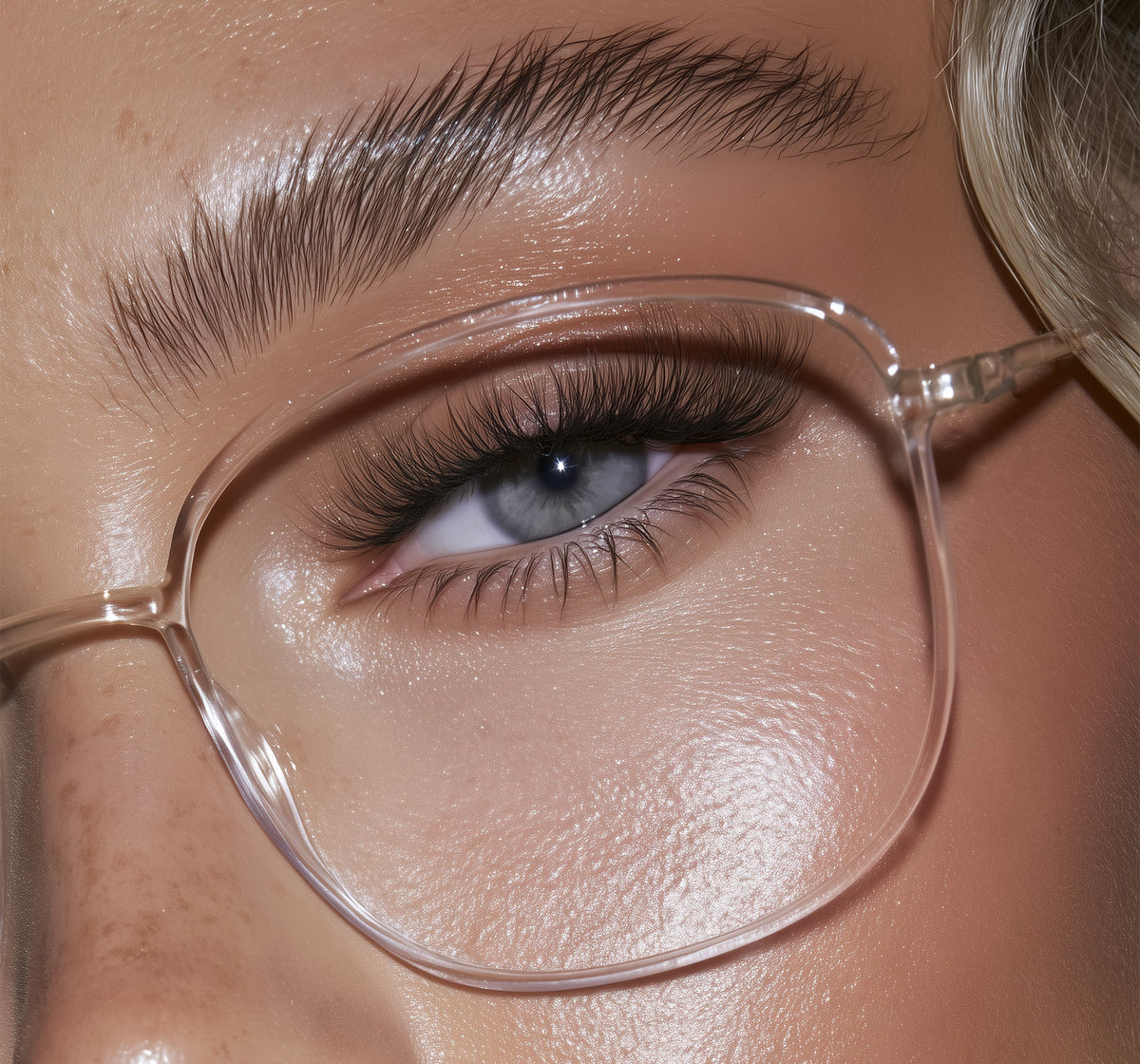
Eyelash Extensions for Glasses Wearers: What Lash Artists Need to Know
Let’s talk about something lash artists deal with all the time but don’t always give enough thought to: glasses.
Yes, your client can absolutely have gorgeous lash extensions and wear their glasses every day. These two things are not sworn enemies. There’s no need to choose between seeing clearly and serving a lash look. But (if only everything were that simple) the glasses do become part of the equation.
The frame sits on the face. The lenses sit in front of the eyes. Some clients have their glasses practically kissing their lashes, while others have enough space between the lashes and lenses to park a tiny car.
Okay, maybe not a car. But you get the point. And if you ignore that little detail during your consultation, you can end up with a set that looks incredible when your client leaves the bed… and becomes a whole different story the second they put their glasses back on.
When working with glasses wearers, your goal isn’t simply to make the lashes shorter. It’s to create a set that works with the client’s eyes, lifestyle, frames, natural lashes, and desired look.
Can Clients Who Wear Glasses Get Eyelash Extensions?
Absolutely. Wearing glasses doesn’t automatically disqualify someone from getting eyelash extensions. In fact, plenty of glasses wearers have beautiful extension sets and go about their daily lives without any drama.
The important part is making sure the extensions don’t constantly interfere with the glasses. And that’s where your consultation earns its paycheck. Some clients wear glasses occasionally. Maybe they throw them on to work at the computer or read a menu that has suddenly decided to use microscopic font.
Others wear glasses from the moment they wake up until they go to bed. Those two clients may not need the same lash design.
Then there’s the actual frame. Some glasses sit farther away from the eyes. Some frames hug the face closely. Some lenses are thicker. Some frames have large, oversized shapes, while others sit much closer to the lash line.
And then there’s the client’s natural lash direction. If the natural lashes already grow forward or slightly downward, adding extensions that project heavily forward can bring the lashes closer to the lenses. If the natural lashes have a strong upward direction, you may have more breathing room.
How Glasses Affect Lash Mapping and Length Choices
When you’re mapping a client who wears glasses, length is only one piece of the puzzle. You’re also considering curl, direction, natural lash strength, eye shape, and, very importantly, how far the lashes sit from the lenses.
Your client might walk in asking for long, dramatic lashes because she saved approximately 47 Pinterest photos titled “soft glam lashes” and has decided today is the day.
Love that for her. But before you reach for your longest lengths, check the logistics. Have her put her glasses on. Look at the relationship between the lashes and the lenses.
- Does the frame sit close to the lash line?
- Do the lashes naturally point toward the lenses?
- Does the client frequently push her glasses up against her face?
These details can influence your map. And the map should make sense for the actual person sitting in front of you.
A beautiful lash map is not just about what looks good in a lash chart. It has to survive real life. Because your client is going to leave your studio and immediately start doing normal-human things: putting on glasses, sleeping, exercising, working, washing her face, wearing sunglasses, and generally refusing to remain perfectly still like a mannequin.
Projection, Not Just Length
This is one of those little details that can save you from a lot of unnecessary troubleshooting. Two extensions can have the same length but create different visual effects depending on their curl and direction.
A stronger curl may create more upward lift and help move the visible lash line away from the glasses.
But that doesn’t mean “stronger curl = always better”. That would be far too easy. Curl selection still needs to make sense for the client’s natural lashes, eye shape, desired result, and application technique.
Your job is to find the combination that gives the client the look she wants without turning her glasses into an accidental lash comb.
Best Curl and Length Combinations to Avoid Lashes Touching the Lenses
There is no universal “best” lash combination for every glasses wearer. Because if there were one magic curl and length combo, we'd all be out of a job by Tuesday.
Instead, think in terms of space, direction, and proportion. For clients whose lashes sit close to their glasses, a moderate length paired with an appropriate curl can often create a beautiful result.
A more lifted curl may help create visual clearance in some cases, while a softer curl may be more appropriate for another client depending on their natural lash direction and the look they want.
The same goes for length. If the client wants dramatic lashes, you don’t necessarily have to shut the whole party down and hand her the shortest extensions in your tray. You can often create drama through density, layering, curl, and mapping rather than simply adding length.
That’s where your artistry comes in. For example, a client may love a fluffy, noticeable look but have very little space between her lashes and lenses. Instead of automatically pushing the length higher, consider where you can create impact without adding unnecessary forward projection.
And remember: natural lash health still comes first. Longer and heavier are not automatically better, even when the client has absolutely fallen in love with a mega-glam reference photo. If the natural lashes can’t comfortably support your chosen extensions, the glasses are the least of your problems. Drama is welcome. Structural chaos is not.
Common Mistakes When Lashing Clients Who Wear Glasses
- Assuming every glasses wearer needs short lashes
Glasses don’t automatically mean short, short, shorter. The frame, lens position, natural lash direction, curl, eye shape, and desired style all matter. Shortening everything without looking at the bigger picture can leave you with a safe-but-boring set when the client could have comfortably worn something more customized. - Forgetting to ask how often they wear glasses
“I wear glasses” doesn’t tell you enough. Does she wear them eight hours a day? Only while driving? Only at home? Does she switch between glasses and contacts? Does she wear sunglasses every weekend? That information matters. A client who wears glasses for 30 minutes a day and a client who wears them for 14 hours are living in completely different lash realities. - Choosing length before checking the frame
This is where things can go sideways. Before committing to your map, take a look at the glasses. You don’t need to perform a NASA-level engineering inspection, but you should understand where the frame and lenses sit relative to the lash line. - Ignoring the client’s natural lash direction
Natural lashes that point forward can behave very differently from lashes that naturally sweep upward. The extension isn’t operating in a vacuum. It follows the foundation underneath it. So look at the natural lashes before deciding how much projection you really want. - Creating a gorgeous set that only works in the lash bed
The set looks phenomenal under your studio lighting. You take the photos. Everyone is happy. Then the client puts her glasses on and suddenly the lashes are negotiating a peace treaty with the lenses. Your job is to create a result that works outside the studio, too.
Consultation Questions to Ask Glasses-Wearing Clients
If your client wears glasses, add a few questions to your consultation. Nothing complicated. Just enough to get the full picture.
“How often do you wear your glasses?” This tells you whether glasses are an occasional accessory or basically part of the client’s face.
“Do you wear contacts sometimes?” Useful for understanding how frequently glasses are actually involved in the client’s daily routine.
“Do your lashes touch your lenses when you blink?” If they already do, that’s valuable information before you choose your map.
“Do you wear prescription sunglasses?” Because yes, those count too.
“What kind of lash look are you after?” Natural? Wispy? Cat eye? Open eye? Full glam? You still need to create the look the client actually wants.
“Have you had extensions before, and did you have any issues with your glasses?” This question is absolute gold. If the client says, “Actually, yes, my lashes kept hitting my glasses,” you’ve just been handed a giant clue. Use it.
And finally: “Can you put your glasses on so we can check the fit?” Simple. Practical. Very worth doing.
FAQ
Q: Can you wear glasses with eyelash extensions?
A: Yes. Wearing glasses does not automatically prevent someone from wearing eyelash extensions.
The important consideration is the relationship between the extensions and the glasses. If the lashes are constantly touching or brushing against the lenses, the client may experience discomfort or find the set inconvenient.
A customized lash map, appropriate curl, suitable length, and consideration of the client’s natural lash direction can help create a more comfortable result.
Q: Do lash extensions look different under glasses?
A: They can. Glasses frames and lenses can change how the lashes are visually perceived, especially depending on lens thickness, frame shape, and how close the glasses sit to the eyes. But that doesn’t mean extensions disappear behind glasses. In fact, the right lash design can still look incredibly beautiful through the lenses.
Q: Should I recommend shorter lashes for clients who wear glasses daily?
A: Not automatically.
Daily glasses wear is a reason to evaluate the lash design more carefully, not a rule that says every extension must be short.
Consider the distance between the lashes and lenses, the client’s natural lash direction, the curl, the desired style, and the strength of the natural lashes.
Sometimes shorter lengths make sense.
Sometimes a different curl or mapping approach solves the problem without sacrificing the look.
The goal is to make the lashes make sense for the client.
Because the best set is the one your client can actually live in. No lens drama. That’s the kind of lash artistry that deserves a standing ovation.




Leave a comment
This site is protected by hCaptcha and the hCaptcha Privacy Policy and Terms of Service apply.