

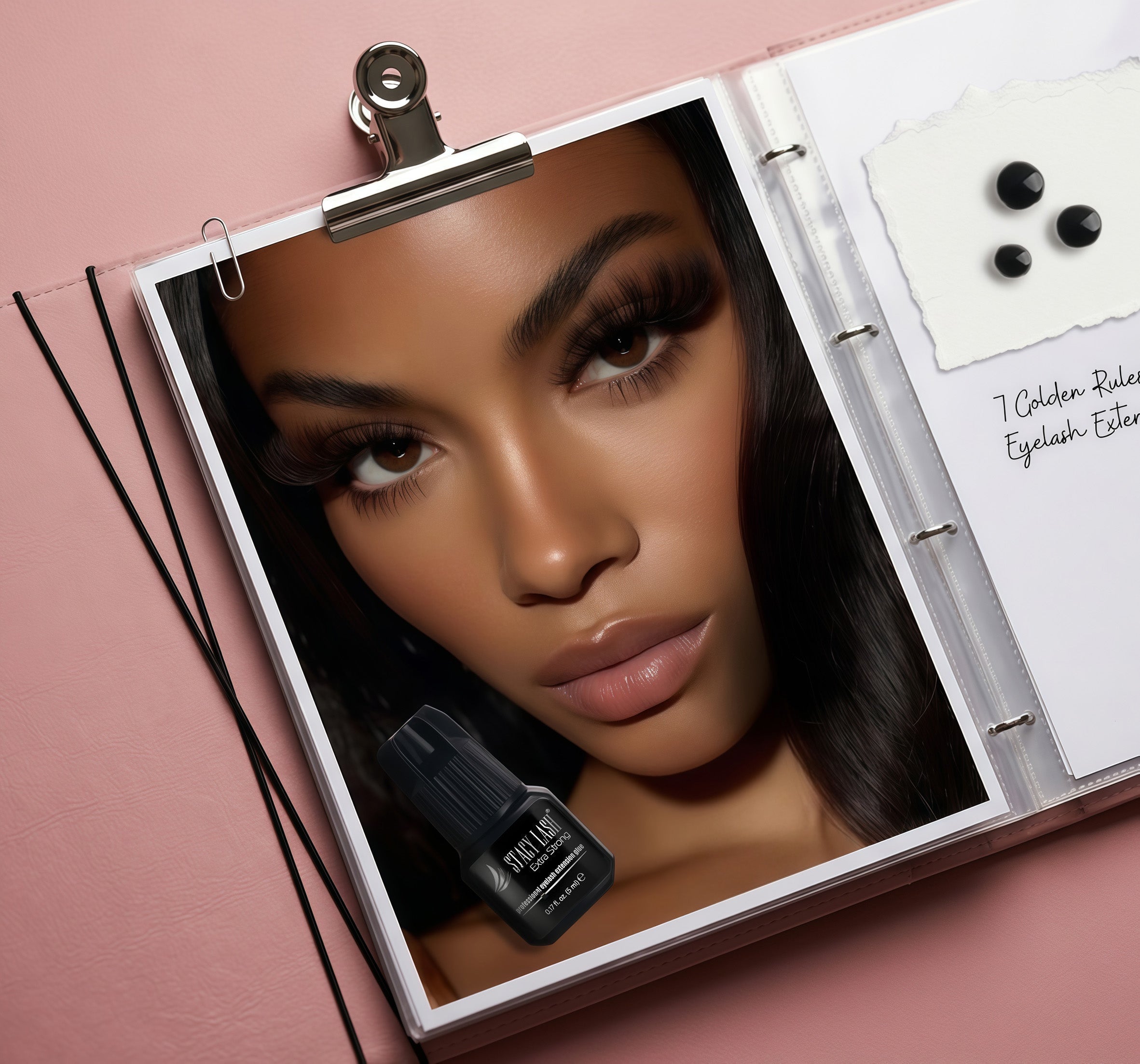
7 Golden Rules of Eyelash Extensions
Applying lash extensions the right way is a bit like stirring a magic potion. One step done wrong, and the whole thing falls apart faster than a house of cards.
That’s why we should talk about the “lash extension rules” of lash application. These are the 101 that keep everything running smoothly as silk. E.g., healthy natural lashes, great retention, and clients who turn into regulars.
Why Lash Results Sometimes Go Sideways
Every artist has had that moment. You followed the routine, used good products, and took your time. And yet… two weeks later, the client messages saying their lashes are shedding like autumn leaves.
Most of the time, the problem isn’t the products or even the client. It’s something else, and it’s really hard to notice. Lash application is a game of millimeters and angles. Miss the mark just a little and the results can unravel pretty quickly. The golden rules for eyelash extensions exist to prevent exactly that.
What Makes These Eyelash Extensions Rules So Important?
Here’s the thing: lash artistry sits somewhere between beauty and engineering. Yes, you’re designing something beautiful. But you’re also building a tiny structure on top of natural lashes that grow, shed, and move every day.
That means everything has to work together hand in glove — isolation, placement, adhesive control, weight distribution, and mapping. When all those pieces line up, the result looks effortless.
When they don’t? Well… that’s when lashes start twisting, popping off early, or irritating the client. And nobody wants that.
Rule #1 — Isolation Is the Foundation
If lash extensions were a band, isolation would be the drummer — not always in the spotlight, but without it, the whole performance falls apart. Proper isolation means separating one natural lash from its neighbors before attaching an extension. Simple concept, right?
Yet this step is where many problems start brewing. When lashes stick together — the dreaded stickies — they begin pulling on each other during the growth cycle. One lash wants to grow, another wants to shed, and suddenly everything is tangled.
Good lash isolation techniques keep every lash moving independently. It protects the follicle, improves lash extension retention, and makes the set feel comfortable for the client.
Rule #2 — The 1mm Sweet Spot
The magic number most artists follow is about 1 millimeter away from the eyelid. Too close and the extension presses against the skin, causing irritation or that annoying poking sensation clients complain about. Too far away and the bond becomes weak. The extension sits on the tip of the natural lash like a hat balanced on a broomstick.
Hit that sweet spot during eyelash extension application and everything settles nicely into place.
Rule #3 — Direction Is Everything
A beautiful lash set isn’t just about length and curl — it’s about direction. Each extension should follow the natural lash at roughly a 90-degree angle, aligning smoothly with the growth pattern. When direction is off, lashes start pointing every which way like a crowd leaving a concert hall.
That not only ruins the symmetry of the set but also makes lashes more likely to snag on pillowcases, glasses, or makeup brushes. Good direction creates that look clients love. The kind that makes people ask, “Wait… are those your real lashes?”
Rule #4 — The Contact Zone Matters
Here’s one of lash extension best practices. The contact zone is the part of the extension that actually touches the natural lash. Ideally, around 40 percent of the extension should sit flush against the natural lash. That surface area gives the adhesive enough room to form a strong bond.
Too little contact and the extension hangs on by a thread. Too much glue in the wrong place and things get messy fast. When the contact zone is right, retention improves dramatically. Lashes stay put through workouts, showers, and the occasional ugly-cry during a sad movie.
Rule #5 — Proper Adhesion Density at the Base
That tiny connection point is basically the handshake between the natural lash and the extension. A good lash bond needs proper eyelash extension application. Not a giant glue blob, not a dry speck — just enough adhesive to create a smooth, even connection along the contact zone.
The goal is a base that sits flush against the natural lash — smooth as butter and solid as a rock.
Rule #6 — Adhesive Control
Use the right amount of glue and everything feels perfect. Use too much and suddenly you’re regretting your life choices. Adhesive control is a skill that comes with practice. Too little glue and the bond won’t hold. Too much and lashes clump together, creating tension and discomfort.
A tiny, balanced bead at the base of the extension is all it takes. When artists master this step, the whole application process becomes quicker and cleaner.
Rule #7 — Balanced Length Transitions
Ever seen a lash set where the lengths jump abruptly from short to long? That’s one of eyelash extension mistakes. Good lash mapping uses gradual transitions so the lengths flow naturally across the eye. Inner corners stay shorter, mid-sections build volume, and outer corners stretch the shape.
It’s a subtle art, but when it’s done right the effect is smooth as silk.
How These Rules Keep Clients Happy
At the end of the day, clients don’t analyze isolation angles or contact zones. They just know their lashes feel good and last long. When the golden rules are followed, the difference shows up in three big ways:
- better retention
- healthier natural lashes
- more comfortable wear
Clients notice when their lashes still look full weeks later. They notice when nothing pokes or pulls. And they definitely notice when their friends start asking who their lash artist is.
Common Mistakes That Sabotage Retention
Even experienced artists sometimes fall into bad habits. A few of the usual suspects include:
- rushing isolation when the schedule gets packed
- using too much adhesive
- placing lashes at awkward angles
- choosing extensions that are too heavy
These slip-ups might seem small in the moment, but over time, they chip away at results. As they say, the devil’s in the details.
Do These Rules Change for Classic, Hybrid, or Volume?
The fundamentals stay the same across the board. Classic, hybrid, volume — they all rely on the same backbone: isolation, placement, direction, and proper bonding. The difference is mainly in how the extensions are built.
Final Thoughts
Lash artistry may look glamorous from the outside, but behind every flawless set is a whole lot of discipline and attention to detail. The golden rules aren’t just lash extension guide — they’re the safety rails that keep the work consistent and professional.
Master them and everything else becomes easier. Retention improves. Clients relax. Your reputation grows. And before you know it, you get fully booked.




1 comment
Wow, this is such a clear breakdown! 😍 Quick question though, do you think beginners should focus on mastering isolation first, or adhesive control? I feel like both trip me up sometimes.
Chloe
Leave a comment
This site is protected by hCaptcha and the hCaptcha Privacy Policy and Terms of Service apply.